Related Posts with Thumbnails

Tuesday, September 4, 2012

Pierre Choderlos de Laclos

Let us bid adieu to Pierre Ambroise François Choderlos de Laclos, author of Dangerous Liaisons, who died of dysentery and malaria on this day in 1803. 

Dangerous Liaisons was a masterpiece of fiction based on the real-life, tangled amorous relations of 18th Century French aristocrats (Any similarity between myself, la Comtesse Marie, and characters within the novel are purely coincidental, I assure you.)

Did you know:

  • Although Laclos successfully wrote about the diabolical machinations of members of the ancien regime, he was actually born into a bourgeois family.
  • One of Laclos's first literary attempts was a comedic opera based on Marie Jeanne Riccoboni's popular novel, Ernestine.  The play, which debuted on July 19, 1777, was a tremendous failure.
  • Marie Antoinette attended the premiere of Laclos's first play.
  • The Chevalier Saint-Georges, a deadly swordsman, skilled equestrian, gifted musician, and unmatched lover, was one of Pierre Choderlos de Laclos's closest friends. 
  • The title of Dangerous Liaisons in French is Les Liaisons Dangereuses.
  • Vicomte de Valmont, the sexual predator in Pierre Choderlos de Laclos's Dangerous Liaisons, was indeed based on a real nobleman, a calculating libertine.
  • For a time, Pierre Choderlos de Laclos served in the French Army.
  • After his stint in the military, Laclos entered the service of Louis Philippe, Duke of Orléans, who was a cousin of Louis XVI and an instigator of the Revolution.  During the Revolution, the traitorous Orléans voted in favor of the execution of Louis XVI.  Karma is just though:  Orléans, who had changed his name to the more republican Philippe Égalité, was later sent to the guillotine.
  • Laclos was buried at Forte de Laclos, a military fort in the Isola di San Paolo in Italy.
  • The 1988 movie, Dangerous Liaisons, starring Glenn Close and John Malkovich, was based on Laclos's novel.  It won three Academy Awards and sixteen other cinematic awards.


First edition of
 Les Liaisons
Dangereuses
from the King's Collection,
Palace of Versailles

Illustration from the first edition
of Les Liaisons Dangereuses.
This engraving, which was
included in the original book,
 was done by Charles Monnet.


Sunday, September 2, 2012

Une fleur pour la reine

Botanical painting by Pierre Joseph Redoute
A mournful gray cloud hovered over Kansas City yesterday, weeping copious tears.  It seemed the perfect day to see Farewell, My Queen.
 
The historical drama depicts the highly fictional relationship between Marie Antoinette and Sidonie Laborde, a young woman selected to be the queen's official court reader.
 
Mademoiselle Laborde, a skilled embroiderer, nurtures great affection for Marie Antoinette, so when she is asked by Madame Bertin to embroider a pink dahlia that will become part of the queen's latest ensemble, she willingly obliges.
 
Watching Sidonie embroider a great pink dahlia got me to thinking about Marie Antoinette's floral infatuation. 
 
Did you know that Marie Antoinette had a rose garden situated on the grounds of le hameau, her private village on Versailles?  Wearing a sheer muslin gown, she would prune the prickly bushes.
Did you know Marie Antoinette liked to add orange blossom water to her hot chocolate?
 
Did you know Marie Antoinette wore an intensely floral scent distilled from the essences of rose, iris, jasmine and orange blossom?
 
Marie Antoinette adored flowers and used them copiously in her personal adornments and decorations.
 
Indeed, it is nearly impossible to find a piece of furniture, wallpaper, or accoutrement that belonged to Marie Antoinette that has not been embellished with flowers.
 

Controversial Vigee Lebrun portrait of
Marie Antoinette in her chemise.
Official portrait of Marie Antoinette by
Elisabeth Vigree Lebrun.  The
queen holds a rose as dark
storm clouds gather behind her,
symbols of the political climate
in France at that time.

Marie Antoinette's coffer.  Notice the
roses painted on the porcelain
panels.

Marie Antoinette's private apartment at
the Chateau de Versailles.  Her bed is draped
in floral fabric.

Le Hameau, Marie Antoinette's
private hamlet on the grounds of
Versailles.  Here, the queen would
tend her roses, milk her cows, and
pluck strawberries from the vines

Marie Antoinette's gown, embroidered
with flowers.

A chair made for Marie Antoinette, covered
in floral silk.

This harp belonged to Marie Antoinette. 
The sound board has paintings of Peace and Minerva,
patroness of artists and clusters of flowers.

Embroidered pocketbook once owned by
Marie Antoinette.  The oval medallion
in the center features sprigs of pink flowers.

Marie Antoinette's chocolate service set, embellished
with blue flowers.

This scrap of fabric was embroidered by one of Rose
Bertin's embroiderers for Marie Antoinette.  Notice
the lovely pink flower.

A Sèvres ice stand made for Marie Antoinette.


Monday, August 27, 2012

Lions & Tigers & Bears, Mon Dieu!


Do you spy the monkey in the bottom left corner of the above engraving by Hogarth?  Does the creature seem to be out of place in the eighteenth century salon? 

Perhaps.

But, did you know that in 18th Century France, many aristocrats kept exotic animals as pets?

Marie Antoinette's chief lady-in-waiting, Laure-Auguste de Fitz-James, the Princesse de Chimay, kept a monkey as a pet.  On fine days, the princesse enjoyed parading her monkey through the gardens at Versailles.  Wearing a tiny suit, he would scamper about, delighting visitors with his silly antics.  Some say the monkey enjoyed more popularity that his mistress.

The princesse was not the only aristocrat in 18th century France to nurture a passion for the exotic.  Parrots, lions, tigers, ocelots, capuchin monkeys, elephants, white peacocks, and leopards were owned by various members of the aristocracy, who would pay to have the creatures brought from Africa, India, or South America.

The naturalist, scientist, and cosmologist, Georges Louis Leclerc, Comte of Buffon, was fascinated with exotic creatures and kept a beautiful green parrot as a pet.  Parrots were an extremely popular pet choice for men and women.
 
In 1782, the prince de Poix arranged to purchase an ostrich, dromedary, camel, tiger, and a pair of lions. In 1783, he added jackals, hyenas, and antelopes to his list of much longed for beasts.


The menagerie at Versailles

Did you know...
  • Did you know there was a Royal Menagerie at Versailles?
  • Did you know Louis XIV once entertained the ambassador of Persia with a gruesome fight between a tiger and an elephant?
  • Did you know Louis XVI encouraged scientists to look upon the Royal Menagerie as a place to further study beasts of the wild?
  • Did you know bear baiting was a popular entertainment within the streets of Paris?
  • Did you know the Saint Germain and Saint Laurent fairs in Paris featured animal shows, which were extremely popular with Parisians?
  • The average citizen could not afford to keep an exotic animal as a pet, but they could purchase engravings of tigers, lions, and assorted exotic beasts?
  • Did you know the Rococo artist Jean-Baptiste Oudry spent much of his time drawing and painting exotic animals?
After the Storm:
For her ties to the royal family, the Princesse de Chimay was briefly imprisoned at the prison Osieaux.  Fortunately, she survived the Revolution.  What became of her monkey nobody knows. 


18th Century Gentleman poses for a
portrait with his menagerie in the
background.

Painting by Jean-Baptiste Oudry

Thursday, August 16, 2012

Gros-Madame: Louis XVI's Other Sister

Louis XVI's other sister, Clotilde

Much has been written about Louis XVI's faithful sister, Élisabeth-Phippine-Marie-Hélène de France, but did you know he had two other sisters?

Marie Zéphyrine was a petite princess with wide blue eyes and a complexion of peaches and cream.  Born in August 1750 - four years before Louis - she would live but a short time.  In 1755, Marie Zéphyrine suffered from violent convulsions and died.   She was buried at the Royal Basilica of Saint Denis outside Paris.

Louis XVI's other sister was Marie Adélaïde Clotilde Xavière, who was born at the palace of Versailles on September 23, 1749.  Clotilde, a plump baby, possessed a voracious appetite.  Courtiers who gathered to watch the royal family at table described her as a "round little ball" who devoured meat, vegetables, and anything else placed before her.  Her dining room antics - and ever widening mid-section - soon earned her a nickname at court - Gros Madame (Fat Madame).  In the painting above, a young Clotilde balances a plate of ripe fruit on her lap as she sits astride a goat.  Her brother, the Comte d'Artois, rests his hand on her shoulder.

When Marie Antoinette arrived at Versailles, she spent much time with her husbands sisters.  Though she liked the pretty, energetic Princess Élisabeth, she found Clotilde to be fat and priggish. 

In 1775, Louis XVI arranged a match between Princess Clotilde  and Charles Emmanuel, the Prince of Piedmont (future King of Sardinia).

Despite her ever growing girth, Clotilde took the baton she was handed and sprinted with it.  That is to say, she devoted herself to her husband.  Theirs would prove a loving matrimony.

Although Clotilde never returned to France, she remained close with her sister.  When Madame Adélaïde and Madame Victoire (Louis XV's doddering, spinster daughters) fled Revolutionary France, Clotilde held out her flabby arms and welcomed them to her palace.

Tuesday, August 14, 2012

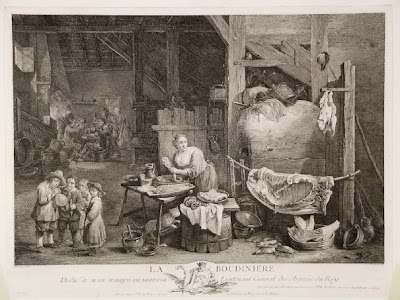
La Boudinière: An Edifying Tale of Sin & Meat


Bonjour Mes Amies!  Please, make yourselves comfortable on the settee beside the fire.  I shall ring for a pot of chocolat and then share with you a tragic tale of misguided passion...

Marguerite Hélène  de Barratte-Cadet was a lovely young woman from a minor noble family.  Graced with skin as smooth and pale as porcelain, hair that shone like strands of ebony silk, and violet eyes with the power to bewitch men, she became her impoverished family's last hope.  The proverbial bait meant to lure riches and restore respectability.

When she was a child, her family sent her to the couvent des Madelonnettes on the rue des Fontaines du Temple so that she might receive an education heavily laced with piety.

Sadly, Mademoiselle de Barrate-Cadet possessed a surplus of beauty, but an alarming deficit of commonsense and morality. 

One fine Spring day - motivated, no doubt, by the restlessness of youth - she decided to venture beyond the shelter of the convent.  Slipping through a crack in the garden wall, she embarked on an exploration of the shadowy corners of that particular faubourg, where the light of the priory des Saint-Martin des Champs did not shine. 

Her wicked walk took her past gaming dens, bordellos, and cafes.  Finally, she came to a medieval road crowded with the maisons de tanneurs et bouchers, where the city's tanners and butchers torture the carcasses of animals for profit.

She noticed a handsome young man with eyes as brown as the leather cape he wore tied about his waist.  He was leaning against a wall, his muscular arms crossed over his chest, staring at her with a forwardness that caused even the tips of her ears to flush.

I shan't elaborate upon the seedier points of this tale - for I am certain you can imagine what happened next. 

Disgrace.  Ruin.  Shame.

Her noble father's most cherished hope - that she would leave the Convent a chaste young woman to enter into holy matrimony - was only partially recognized. 

She wed the handsome young man in the leather cape - a butcher's son with a penchant for expensive drink and cheap women. 

Now, she spends her days in a fetid shack in the downtrodden Faubourg Saint-Marcel, grinding slabs of meat, her fingers stained red from blood. 

I believe I have an engraving of her here somewhere...

Ah! Yes!  Here it is, beneath a pamphlet decrying the Duke of Orléans's licentiousness.


As you see, it is entitled La Boudinière.  In French, a boudinière is a funnel used for grinding meat.  Notice the animal carcass hanging between two posts behind Marguerite Hélène

How my heart aches for this silly, stupid woman.  In pondering my own fate, I often feel melancholy over my loveless marriage.  Still, I would rather be married to a fat Comte with an equally fat purse than a impoverished meat grinder.  Wouldn't you?

~ The Comtesse de Saint-Simon

**While on a tour of northern France, I found this engraving in a small shop in Dinan, France.  I have been collecting 18th century engravings for many years.  I prefer romantic scenes and landscapes of France, but something about this engraving captured my imagination.  I found myself wondering about the woman grinding the meat.  I have created this tale to go with the image.  In truth, the woman's identity has probably been lost to history.  ~Leah Marie Brown